


Sharpal 129N Carbide Sharpener – Field Test
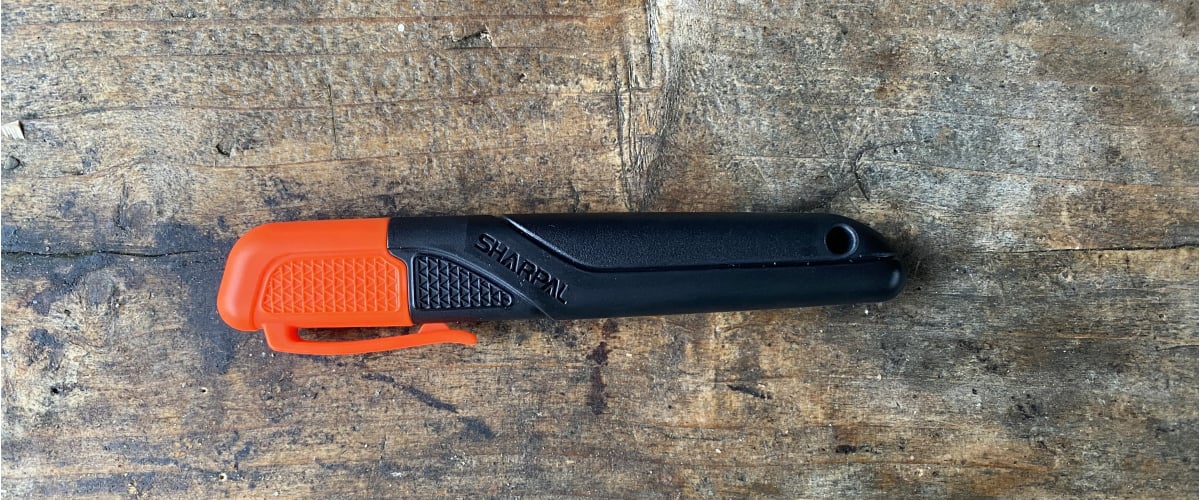
The arrival of this product for testing came as something of a surprise. While testing Exotac fire starters, several positive features emerged, but their ignition power proved somewhat lacking due to the dispersed spark pattern. During further research, I discovered numerous U.S.-based users reporting excellent results using a carbide sharpener as a striker. The idea seemed worth exploring, and Lamnia managed to source a suitable model through a subcontractor, which ultimately reached us for testing.
Overview
The Sharpal 129N is a compact field sharpener that visually resembles a utility knife. It measures 13 cm in length, 2 cm in width, and just over 1 cm in thickness, weighing 32 grams. The body is plastic-coated and includes a hole at the handle end for attaching a lanyard. At the opposite end is a flat blade section, protected by a small plastic cap fastened with a miniature screw to prevent accidental drops. An additional removable plastic sheath with a clip (e.g., for belt attachment) covers the blade.
The product has earned a legendary reputation as a quick sharpener that removes steel using a carbide edge. The appeal lies in its dual function – a pocket-sized sharpener that also doubles as a high-performance fire steel striker. We set out to verify whether the reputation was justified.
Striker Comparison
Traditionally, fire starters are struck using the spine of a fixed-blade knife. In this case, no separate striker is needed, as a knife is typically part of an outdoor gear setup. However, this technique requires a ground, sharp-edged spine –something not all knives feature. Even when present, the ignition power and control tend to be suboptimal. Additionally, striking with the cutting edge up exposes the user to injury if grip is lost.
Standard strikers included with fire starters or bought separately are typically thin flat steel strips and quite small. These perform better than knife spines but are ergonomically lacking.
Carbide sharpeners represent the most advanced generation of striker tools. The carbide sharpening edge is extremely durable, and many manufacturers claim it can last a lifetime. Rubber or plastic grips offer better comfort –especially in cold weather – compared to steel alternatives. The blades are also covered by protective caps.
In this respect, Sharpal goes a step further than other common carbide sharpeners such as the Speedy Sharp popular in the U.S. Notably, the Sharpal is one of the few models on the market that features two sharpening edges: a tungsten carbide blade and a ceramic honing edge on the reverse side. According to the manufacturer, the carbide element is suitable even for harder steel grades. The ceramic side allows for polishing and fine deburring. Additionally, Sharpal features a contoured handle and a locking sheath – an upgrade over the Speedy Sharp in terms of finish and functionality.
Sharpal also offers a very similar model tailored to outdoor use: the 123N, which features a larger, more ergonomically shaped rubber-coated grip and is slightly heavier than the 129N tested here.
Performance as a Fire Steel Striker
When used with Exotac fire starters, Sharpal's performance far exceeds standard strikers. Both tested Exotac rods generated larger sparks with the carbide sharpener. Ignition was significantly more reliable, and a fire starter block made of compressed pine shavings and vegetable oil ignited quickly with both rods. The FireROD XL model even allowed distance ignition, launching sparks into the tinder pile from several centimeters away.
Even the smaller fireROD V2, when used with the Sharpal, clearly outperformed the XL when paired with a standard striker. The smaller fireROD V2's light strike effort made fire-starting easy and safe. The XL rod, while offering greater ignition power, required more force, and the deep grooves formed on its ferrocerium surface occasionally hindered performance with the carbide edge.
It’s worth noting that the carbide blade is highly aggressive and wears down ferro rods faster than standard strikers. However, the faster ignition reduces overall wear, somewhat offsetting this effect. Users should be mindful not to apply unnecessary force. Thanks to its plastic-coated grip and larger contact surface, Sharpal offers better control and comfort than thin metal strikers.
Exotac Paired with Sharpal: Impressive Results
Exotac fire starters are beautifully designed tools and deserve a worthy striker. The Sharpal 129N carbide sharpener unlocks their full ignition potential. With both models, ignition was quick and reliable, thanks to the larger sparks. The compact combination of the Sharpal and fireROD V2 is fully sufficient for outdoor use. For maximum performance, the FireROD XL + Sharpal combo is highly recommended.
Performance as a Field Sharpener
The Sharpal was also tested for quick sharpening of a Peltonen Knives Sissipuukko and a Fiskars outdoor axe. Sharpening is done by lightly drawing the blade edge-first through the carbide side several times toward the tip, on both sides of the blade. For finishing, the ceramic edge is used with 3–5 light passes per side. The same technique applies, with minor adjustments, to the axe.
During use, it became clear that caution is required – especially with the carbide side – as it is so aggressive that it can easily damage the edge if used carelessly. The quick edge refresh noticeably improved sharpness, especially in the field. However, it is not suitable for fully restoring heavily dulled blades. It cannot replace full sharpening tools but excels in quick field touch-ups.
Design Shortcomings
The plastic tip guard protects against impact (e.g., drops), but the mounting screw loosened during testing, leading to blade looseness. The Sharpal’s blades are not fixed to the body, so if the screw comes undone, there’s a risk of the blades falling out and getting lost. Retightening the screw resolved the issue. However, the screw uses a 1.5 mm hex key, which is an uncommon size not typically found in standard toolkits. If the issue reoccurs, thread-locking compound may be necessary.
A more robust design would permanently fix the blades into the body, eliminating the need for a guard tip but improving reliability. (A second sample provided for testing did not experience this issue.) In its current form, users should occasionally check that the screw remains tight.
Additionally, a rubberized, ergonomically shaped handle would improve grip. Interestingly, this feature already exists in Sharpal’s 123N model. It would have been interesting to compare the 129N and 123N side-by-side to identify the best option.
Conclusion
Despite its flaws, the Sharpal 129N carbide sharpener is a game-changing tool that solves multiple challenges. When used as a fire steel striker, it produces exceptionally strong sparks, dramatically improving ignition performance. It also works well for quickly sharpening dull blades in the field. Thanks to its compact size, comfortable grip, and affordable price, the Sharpal is a great companion for outdoor adventures.
For anyone serious about bushcraft, fire-starting, and blade maintenance in the field, the Sharpal is a must-have. I recommend it almost without reservations to any self-respecting outdoor tinkerer.