


Silky Gomboy Curve Outback Edition Camp Saw Review
When handled properly, fire is one of the most valuable tools available to an outdoor enthusiast. It enables cooking, provides warmth, dries wet clothing, creates atmosphere, serves as a source of light, and can even function as an emergency signaling device. Firecraft is therefore one of the fundamental outdoor skills.
At campsites, the available firewood is often limited to longer logs, and there may not always be a functional saw on hand. Carrying firewood on extended trips can become burdensome, especially when traveling on foot. Fallen branches found on the ground can often be used as fuel, but processing them occasionally requires woodworking tools. Fallen trees may be utilized where permitted by the landowner.
A puukko-style knife is good for preparing kindling, but its capabilities quickly reach their limits when dealing with thicker pieces of wood. In addition to splitting, an axe can also be used to cut through wood, although this generally requires an axe of different size and weight class than a typical camp axe. More capable camp axes can likely be used for cutting through wood, but the work may still be very laborious. For this purpose, a camp saw is the most suitable tool.
A good camp saw makes it easier, and indeed possible, to cut through tree trunks and thicker branches. It should provide sufficient cutting performance while remaining efficient enough to justify carrying it in the first place. A camp saw should also be sufficiently lightweight and compact so that it can be carried in a backpack, rucksack or even a pulk alongside other essential equipment. Durability is equally important, as is safe blade protection during transport through a sheath or folding design.
Japanese manufacturer Silky has earned a reputation for producing highly effective folding saws. With more than a century of experience, the company is particularly well known for its legendary Gomboy series. One of the latest additions to the lineup, the Gomboy Curve Outback Edition, promises impressive performance. Designed specifically for outdoor use, the Outback Edition claims to offer improved cutting efficiency, effortless operation, and excellent field functionality. We set out to discover whether the reputation is justified and tested the saw in outdoor use.
Camp Saw Comparison
Camp saws can generally be divided into four categories based on blade design and deployment method: fixed-blade saws, folding saws, retractable saws, and collapsible frame saws. Each design offers its own advantages.
Fixed-blade saws feature a blade that is permanently attached to the handle. This construction is typically robust and durable. The main drawback is the amount of space required for transport, particularly with larger models. A separate blade guard or sheath also adds to the overall packed size.
Folding saws are structurally similar to folding knives. The blade locks into the working position and can be folded away using a release mechanism. When folded, the blade rests safely against the underside of the handle, effectively reducing the transport length by roughly half. This design combines a sufficiently long blade with a compact packed size. Some models also support replaceable blades. On the downside, the design relies on the locking mechanism functioning properly, and the handle does not provide quite the same level of support as the one-piece construction found on fixed-blade saws.
In retractable designs, the blade slides into the handle, protecting the user during transport. These models share many of the strengths and weaknesses of folding saws. The most critical factors are the solidity of the blade lock and the feel of the handle in use.
Collapsible frame saws are foldable designs that form a hinged polygon-shaped frame when assembled for use. They are the most compact option to carry. The polygonal frame also makes a two-handed grip possible. These models typically use standardized blades that are widely available and relatively inexpensive. However, these blades do not offer the same level of performance as other saw designs in terms of blade geometry, size, tooth pattern, material and surface treatment. Additional drawbacks include slower deployment and folding. In terms of weight, collapsible frame saws are not necessarily lighter than comparable folding or retractable models, although this varies between individual designs.
Features and Design
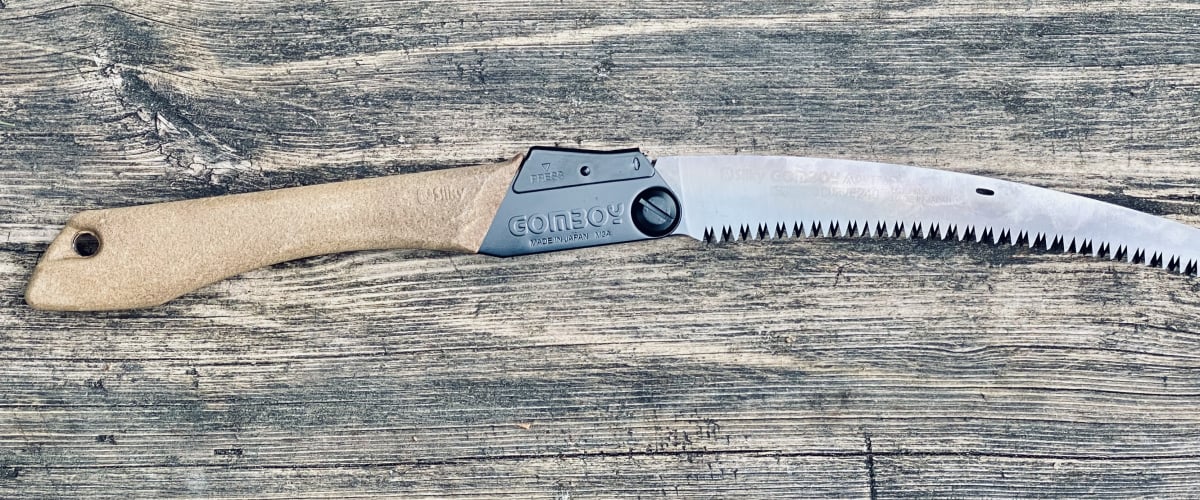
For those accustomed to conventional camp saws, the Silky Gomboy Curve Outback is a rather exotic-looking tool. Resembling something closer to a jungle samurai's knife than a traditional wood-processing tool, the saw is packed with several interesting design features. Designed specifically for outdoor and tactical use, this special-edition model features a blade that folds into a wood-composite handle. Standard Gomboy models typically use Silky's rubberized grip, a feature that has contributed significantly to the brand's reputation. According to the manufacturer, the alternative material used in this special version provides a warmer feel in cold conditions and improved grip when wet, although it does sacrifice some of the handle feel compared to the standard models. The handle incorporates shaping and a dot-pattern texture to improve grip. Its length and profile are designed so that the user can choose their grip position freely along the entire handle. The blade cuts wood only on the pull stroke. The purpose of this feature is to reduce sawing effort and blade wear by eliminating the stress associated with the push stroke.
The handle and blade are connected by a steel frame that runs the full length of the saw, extending from the end of the handle to the blade pivot. Positioned on top of the frame, between the handle and blade, is a push-button locking mechanism. When the blade is opened, a transverse pin located at the front of the button engages with a locking notch in the blade and locks it into position. By pressing the button and rotating the blade, it can either be folded back into the handle or rotated outward into its secondary working position. In this second position, the blade opens beyond the standard cutting angle. The purpose of this alternative angle is to improve access when sawing in confined spaces and to provide additional flexibility in grip position. The saw does not have a lock in the closed transport position.
The Blade as the Highlight
One might assume that a saw blade is among the simplest metal components to manufacture. While that may sometimes be true, it certainly is not the case with Silky. The blade, which is the highlight of the saw, is packed with development work and features. Laser-cut from Japanese SK4 carbon tool steel, the blade has a curved profile designed to improve cutting efficiency and help it remain in the saw kerf. The blade sides remain flush with the teeth, and the teeth are arranged in two asymmetrical rows. This non-set tooth design is intended to reduce cutting resistance, increase cutting speed, and produce a smoother cut.
The teeth feature the manufacturer’s patented Mirai-Me sharpening, in which every tooth is precision-ground on four separate cutting surfaces. They also incorporate the manufacturer's scraper-like Gokai-Me tooth geometry for efficient sawdust removal and optimize performance during rip cuts, crosscuts, and slant-cuts. According to the manufacturer, impulse hardening of the tooth tips keeps them sharp approximately three times longer than unhardened teeth while preserving the flexibility of the unhardened blade body. The blade is coated with a black nickel-tin finish to improve corrosion resistance and durability while reducing glare. Manufacturer also claims that the blade is capable of cutting not only wood but also bone, making it suitable for hunting use as well.
Protective Case and Dimensions
The saw is supplied with a transparent plastic protective case. The hinged lid locks to the lower section of the case. The upper portion of the belt clip folds into matching recesses in the lid, providing additional retention while simultaneously preventing the clip from detaching from a belt when the case is open. There are attachment holes in both the belt clip and the base of the case. The bottom also incorporates drainage holes for moisture removal.
The saw measures 51 cm when fully deployed, of which the blade accounts for 24 cm. Folded length is 28 cm. Our measurements recorded a weight of 295 g for the saw and 125 g for the carrying case. The blade produces a kerf width of 1.3 mm, while tooth spacing measures 3.75 mm.
Field Testing and User Experience
The compact size of the saw and its pull-cut-only design did not initially inspire the highest expectations regarding cutting performance. Those doubts proved unfounded, and the saw performed very well in practical testing.
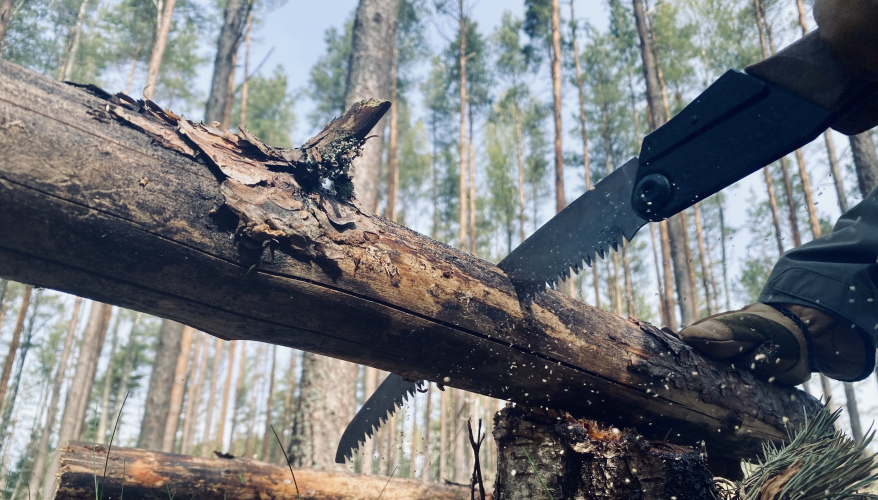
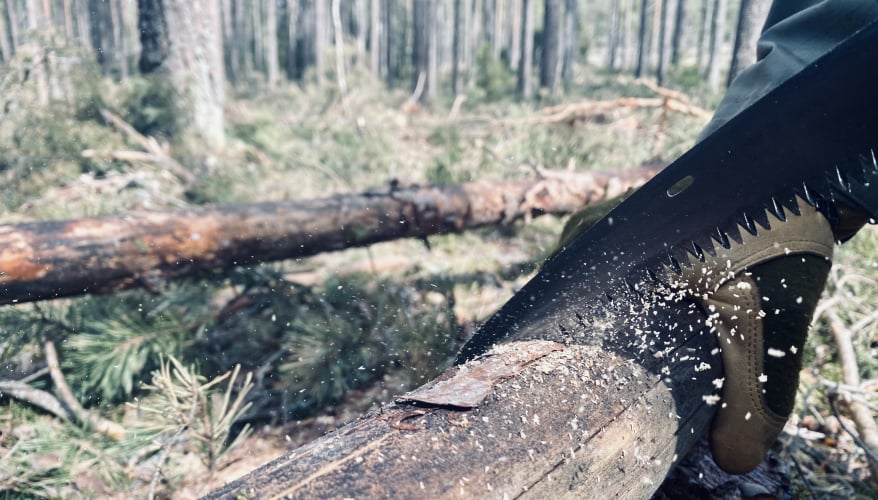
Creating the initial cut is not always easy with a camp saw. The blade may fail to create a defined groove and can twist, making sawing more difficult. Silky’s curved blade bit into the wood quickly and almost effortlessly. Establishing a kerf and keeping the blade tracking accurately proved exceptionally easy. The sophisticated tooth geometry appeared to work as intended, and the saw cut wood with minimal effort. Sawdust was also cleared efficiently and never accumulated enough to hinder performance. The resulting cut surface was exceptionally straight and smooth for a camp saw, although variations in wood and cutting conditions naturally affected the final result.
The manufacturer's stated cutting capacity of 12 cm is consistent with practical observations, as the saw can still be operated with a fairly free stroke at that diameter. It would likely work on slightly thicker wood as well, but it is not intended for cutting larger trunks. The secondary blade position proved useful when cutting the underside of a trunk resting only slightly above the ground. This position was more ergonomic and made the cut possible, although not as efficiently as cutting from above in the standard position. It was also possible to cut through an 80 cm log stood upright on a stump using the secondary blade position, although the work was somewhat laborious. The adjustable blade angle therefore does not replace proper sawing ergonomics, but it is beneficial when working in awkward or confined situations.
The handle was found to be comfortable, although the Outback special edition does not quite match the comfort of the rubber handle found on the standard Gomboy models. The balance was also good, making the saw easier to control.
The Protective Case Is a Matter of Preference
Due to the curved blade and the design of the handle, the center section of the folded blade only just fits within the handle. As the blade also does not lock in its transport position, carrying the saw without external protection creates a risk of the blade opening inside a backpack, pocket, or other storage location, potentially damaging gear or causing injury. For this reason, we would not recommend storing or transporting the saw without its protective case.
The original protective case protected the saw well, and its transparency made it possible to assess the need for basic maintenance and cleaning at a glance. The case is also suitable for long-term storage. However, it is heavy and fairly bulky, occupying valuable space in a backpack. Carrying the case on a belt made deployment easier and faster, but a saw hanging in a transparent belt case with its sharp teeth visible creates a certain impression of the outdoorsman carrying it, one that may not always be desirable in every situation.
Whether one prefers the case's good protection, belt-carry capability and the advantages provided by its transparency, or a more compact and softer cover that also keeps the saw out of sight, is largely a matter of personal preference. Personally, I would have preferred the latter option. That said, the manufacturer's carrying case is exceptionally well executed for a plastic design.
Maintenance and Blade Replacement
Proper maintenance is essential for keeping outdoor equipment functional and reliable in the field. In this case, it is particularly important. The blade offers exceptional cutting performance and durability, but it is neither stainless nor resharpenable. The blade can certainly be replaced, but replacement blades are not among the least expensive, and retiring a blade prematurely would be little more than waste.
The manufacturer recommends keeping the blade clean and dry whenever the saw is not in use. A solvent spray removed cutting residue effectively from the blade. After cleaning, the blade appeared almost new. When compared with a brand-new replacement blade, the difference was marginal, and we observed little more than minor wear marks in the coating.
The blade is secured to the frame by two bolts, one of which features a slot for a large flat-head screwdriver. The opposing bolt incorporates a shaped backing surface that interfaces with raised pattern on the frame, preventing it from rotating during tightening or removal. The solution is ingenious and eliminates the need for a second tightening tool.
After testing, we inspected the blade pivot hardware and found no signs of loosening. Blade replacement was also quick and straightforward. The process was so easy and fast that, depending on circumstances, carrying a spare blade may even be justified, provided it is protected from bending.
Conclusion
Unlike typical compact camp saws, with which sawing is often time-consuming and laborious, the Silky Gomboy Outback brings a refreshing touch from the world of well-made hand tools. It is a well-executed, ergonomic and well-balanced woodworking tool that turns sawing into a comprehensive experience combining the satisfaction of work and the mark of one's own craftsmanship. The blade's bite, cutting efficiency, sawdust clearance and cut quality were excellent for a saw of its size. The adjustable blade angle provides additional benefit when cutting from below or in ergonomically challenging situations.
A compact blade has its limitations. If the intention is to cut larger logs, a model equipped with a longer and more rigid blade should be chosen. The saw also requires appropriate care and consideration in use. Pressing or twisting the blade should be avoided in order to prevent premature wear and breakage. It is also advisable to check the tightness of the blade pivot hardware at suitable intervals and whenever necessary. The blade should also be kept clean and dry.
The Gomboy Outback combines a compact design with very good control and sawing experience. It is an excellent camp saw suitable not only for preparing firewood but also for building emergency shelters, trail clearing and general garden work. If the manufacturer's claim regarding its ability to cut bone proves accurate, the saw may also be suitable for hunting use. In my opinion, the price is also justified considering the exceptional quality and performance it offers.