



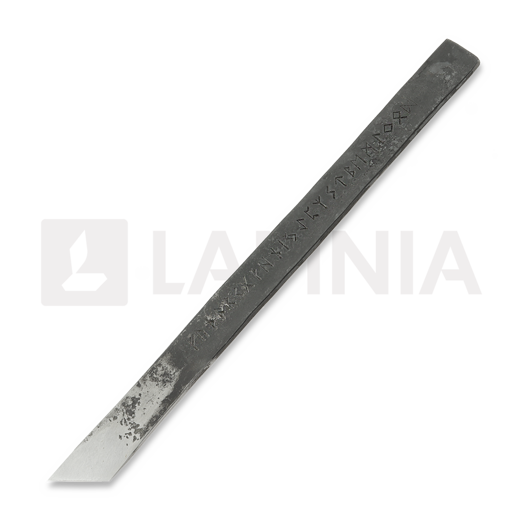
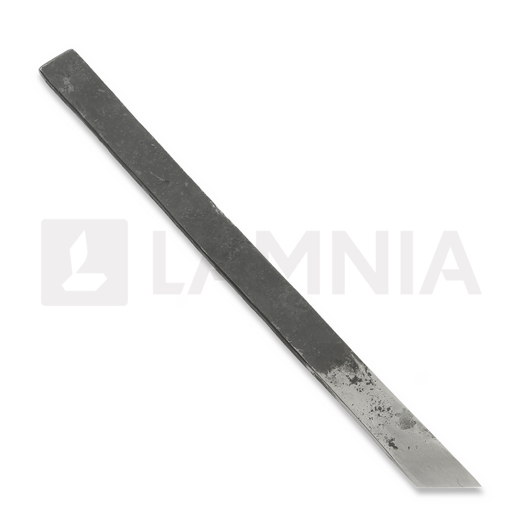


Juha Perttula Rune knife, Limited Edition

Kirjeldus
Nobody knows, but I am pretty sure that runes evolved from Roman letters when Germanic tribes carved letters into wood with knives (Romans used pen and ink). Runes have only vertical and diagonal lines thus, they can be carved into wooden sticks so that problematic lines along wood grains or difficult circles can be avoided.
Basically, my rune-knife is a traditional wood-carving or leather-cutting knife, but it gets its name from the punched runes on it, and I use it for that very purpose. I am not sure how frequently Germanic tribes carved runes with this style of knife, but regardless, it is a proper tool for the job. Of course, you can carve runes with any knife or just scratch them with a sharp nail. The bare steel handle is traditionally improved by wrapping a leather strap around it, but on my personal rune-knife, I use a hockey tape ring between the edge and runes.
The rune knife is 80CrV2 steel that is hand-forged and hardened in a gas-fired blacksmith’s forge, and tempered in a kitchen oven at 170°C temperature, so it is very hard (about 63 HRC). I used freehand sharpening because it naturally produced a slightly convex profile, which is strong and cuts well. Approximate width 10 mm, thickness 2.5 mm, and length 120 mm.
Tehnilised andmed
Tera
80CrV2 Süsinikteras
Blade style
Straight back
Kõvadus
HRC 63
Käepide
Kask
Tupp
Nahk
Kaal:
0.776 oz
Kogupikkus:
5.16″
Tera pikkus:
0.39″
Tera paksus:
0.1″
Päritoluriik:
Soome
Muud andmed
Piiratud partii

Heitmete kompenseerimine

Keskkonnasõbralikum materjalide kasutus

Allikad loodusest

Sest see on lihtne, kuid oluline.
Lamnia spetsialiteediks on muljetavaldav noavalik, mis koosneb enam kui 5000 noast ja taskunoast. Meie tootevalikust leiate sadu Soome Puukko nuge, taskunuge, jahinuge ja köögiriistu maailma parimatelt kaubamärkidelt nagu näiteks Spyderco, Böker, Roselli, Fox Cutlery ja Cold Steel.